.svg)
Full wavefield AVO inversion
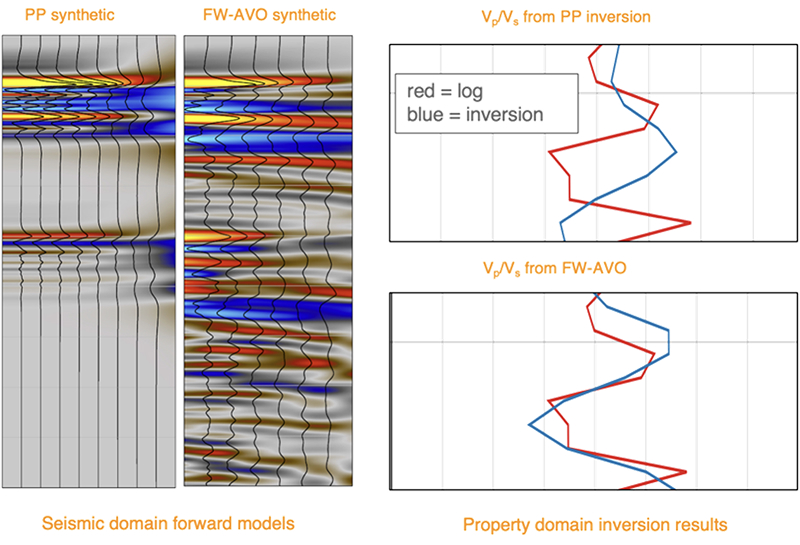
Where conventional inversion treats multiples, mode conversions, and attenuation as noise to be removed, our FW-AVO approach treats them as signal. By accounting for the full elastic wavefield, the inversion recovers subsurface properties that standard methods miss – applicable to both new and legacy data, in land and offshore settings.

Commercial highlights
- Released in 2024
Client value
- Time depth relationships accounting for dispersion
- Improved reservoir characterisation in the presence of short period multiples, mode conversion, anisotropy, dispersion and attenuation
- Can be applied to both new and legacy data
Technical highlights
- Fast, accurate, flexible forward model
- 1.5D approximation to elastic full wavefield inversion
- Inversion uses all the energy in the gather to estimate the true subsurface properties
- Demonstrated in land and offshore settings and on 2D & 3D and PP/PS data
- Outputs available in seismic and elastic property domains






"The strength of our full wavefield AVO inversion is that it captures important waveform and AVO effects while remaining practical for conventional seismic workflows. It gives us a robust bridge between standard AVO inversion and full elastic FWI."
Full wavefield AVO (FW-AVO) - A technical description
Incorporating full AVO information in FWI is usually considered computationally expensive, as accurate 3D full elastic solutions to the wave equation are required. Qeye’s full wavefield AVO inversion uses the 1D tau-p domain wave-equation as the forward seismic model in the inversion loop. A big advantage is that it can be fitted, relatively easily, into a conventional seismic processing workflow, including one that involves conventional 3D FWI. The proposed approach assumes that the subsurface is slowly varying horizontally making it less computationally expensive than 3D elastic FWI by many orders of magnitude in terms of compute time and memory. Additionally, far-angle data can be contaminated with converted waves and internal multiples that make the inversion extremely challenging. By accounting for these effects, the waveform-based method can mitigate inadequacies in primaries-only inversion caused by non-primary energy in the seismic, arising from e.g. reverberations and mode conversions.