.svg)
Low frequency modelling
The low-frequency component of the earth model is built using well logs, seismic horizons, and seismic velocities. Our algorithm supports multiple depositional systems, handles complex faulting automatically, and includes built-in blind well testing to validate model predictability before it feeds into the inversion.



"A good low-frequency model should not be a smooth guess between wells. It should be geologically guided, fault-aware and tested against blind wells, so the inversion has a reliable background model rather than a hidden source of bias."
The Qeye low-frequency modelling uses well logs, seismic horizons and seismic velocities.The algorithm supports the following features:
- Different depositional systems can be used between the horizons (conformable, on-lapping and off-lapping)
- Radial basis function interpolation
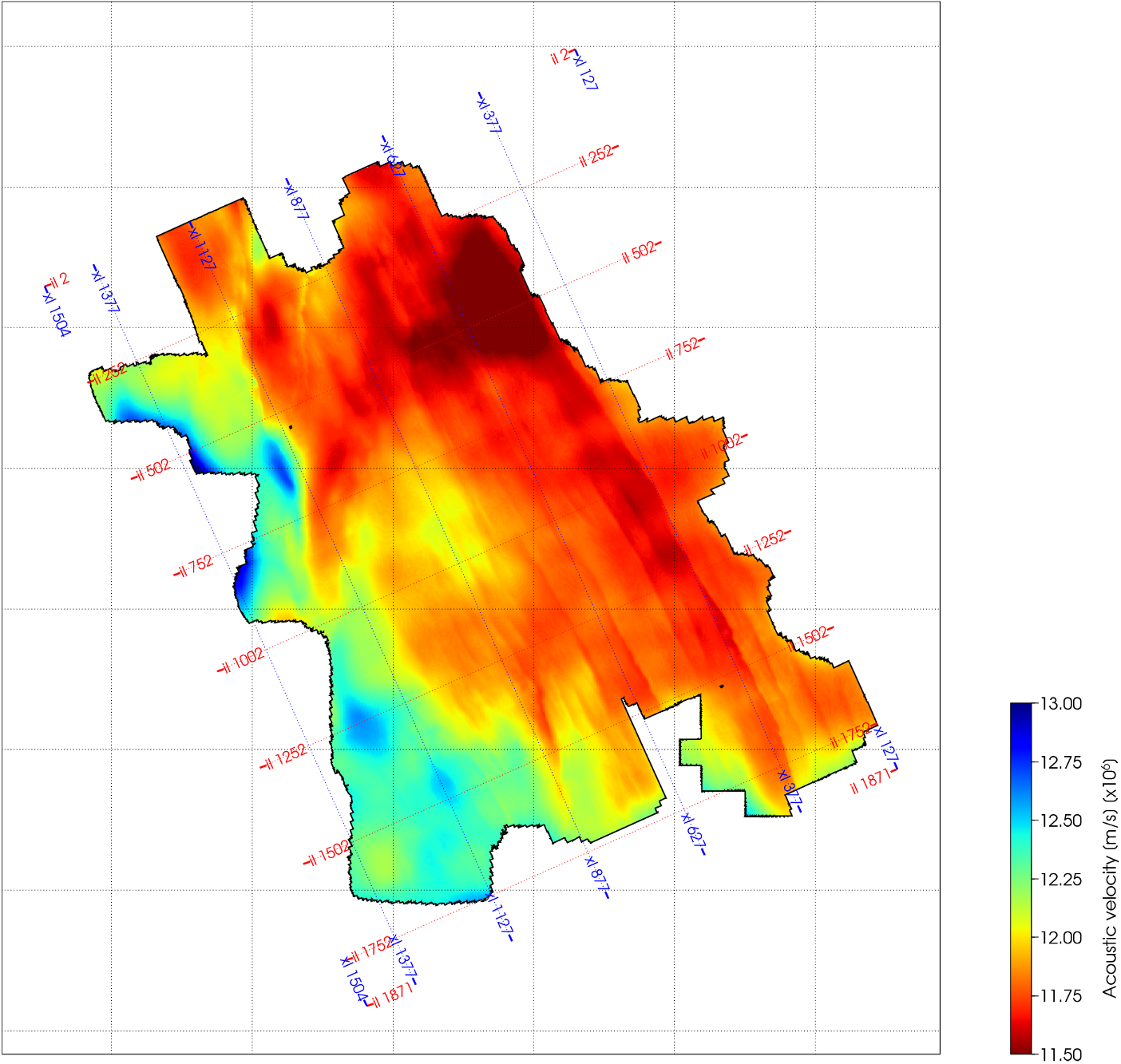
- Interpolation guidance between wells using seismic velocity trends
- Application of depth trends
The low-frequency model building can handle any number of faults per trace and any type of fault (normal or reverse). The type of fault can be automatically derived, and QC diagnostics such as slip of a horizon across a fault can be computed.
The low-frequency model building can optionally be facies driven by building models for each facies using well data filtered to each specific facies and using a facies classification tool on relative seismic inversion results to produce a facies weight to be applied to each lithology low-frequency model.
The low-frequency model building can also be driven by RMO updated velocities via a proprietary implementation of the Swan method.
As a part of the low-frequency model building, an analysis of the predictability of the low-frequency model is performed by computing a low-frequency model at each well location, where this actual well has been removed from the input wells. In this way it is effectively treated as a blind test well for the low-frequency model building. This can be conducted for different versions of the low-frequency models in order to analyse the models’ validity.