.svg)
Seismic AVO inversion
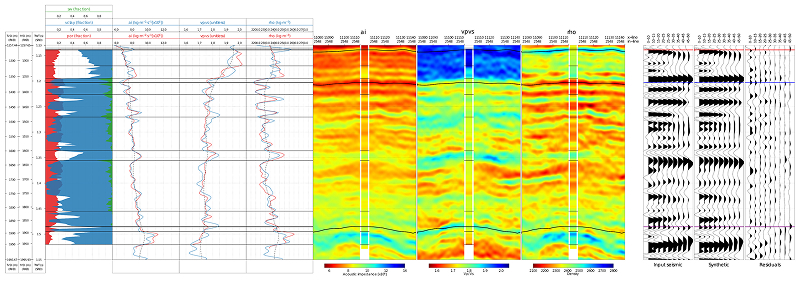
The Qeye inversion engine is a globally optimised, full bandwidth algorithm that inverts all input seismic stacks simultaneously for the best-fitting earth model. It supports a range of AVO models including anisotropic formulations, handles large datasets without segmentation, and accommodates spatially and temporally varying wavelets.

"The strength of our simultaneous AVO inversion is its ability to handle imperfect seismic data in a controlled way. We explicitly balance seismic misfit, prior-model consistency and lateral stability, so the inversion remains robust even where noise and data quality vary across the survey."
Historically, seismic data was used to generate images of the geological structure subsurface. Modern quantitative interpretation (QI) extracts additional, high value information from the (usually prestack) seismic data.
The variation of the seismic amplitude with incident angle (AVO) (and azimuth – AVAZ) at a geological interface contains information on the rock and fluid properties in the layers.
The key steps in all QI workflows use the AVO information to convert the seismic data from amplitude at an interface to properties in a layer. The process is controlled and calibrated by any available well log data and by traditional structural interpretations from the stacked data.
This process is called seismic inversion. Seismic inversion estimates the elastic and petrophysical properties in the subsurface away from the wellbore.
The Qeye inversion is a globally optimised, full bandwidth algorithm. It inverts all input seismic stacks simultaneously for the best fitting earth model. It uses the simulated annealing algorithm, which belongs to the class of global optimisation schemes capable of locating the global minimum of a given function (e.g., minimisation of the error function describing the misfit between modelled and observed data). Unlike some commercially available software packages, the Qeye algorithm does not linearise the AVO functions or make any a priori assumptions of a relationship between the terms.
The inversion can be performed using one of a number of AVO models (including anisotropic models) to enable an optimal choice for the given data. The engine is able to handle very large datasets without segmentation of the input data. In addition, the input wavelets can be varied both horizontally and vertically to accommodate for spatial and temporal variations of the input data.
Qeye is able to handle any combination of the following data types to invert for elastic (e.g., acoustic impedance, Vp/Vs and density) and petrophysical parameters (e.g., porosity, volume of clay and water saturation):
- AVO stacks
- Azimuthal AVO stacks
- 4D AVO stacks
- PP&PS AVO stacks
The 4D mode of operation inverts simultaneously and symmetrically for the 4D changes in elastic parameters and/or petrophysical parameters.