
.svg)
Time lapse inversion
By simultaneously inverting multiple monitor vintages with proprietary 4D AVO preconditioning, we isolate what has changed in the reservoir – saturation, pressure, and fluid movement. The result is calibrated property volumes ready for direct comparison with reservoir simulations.
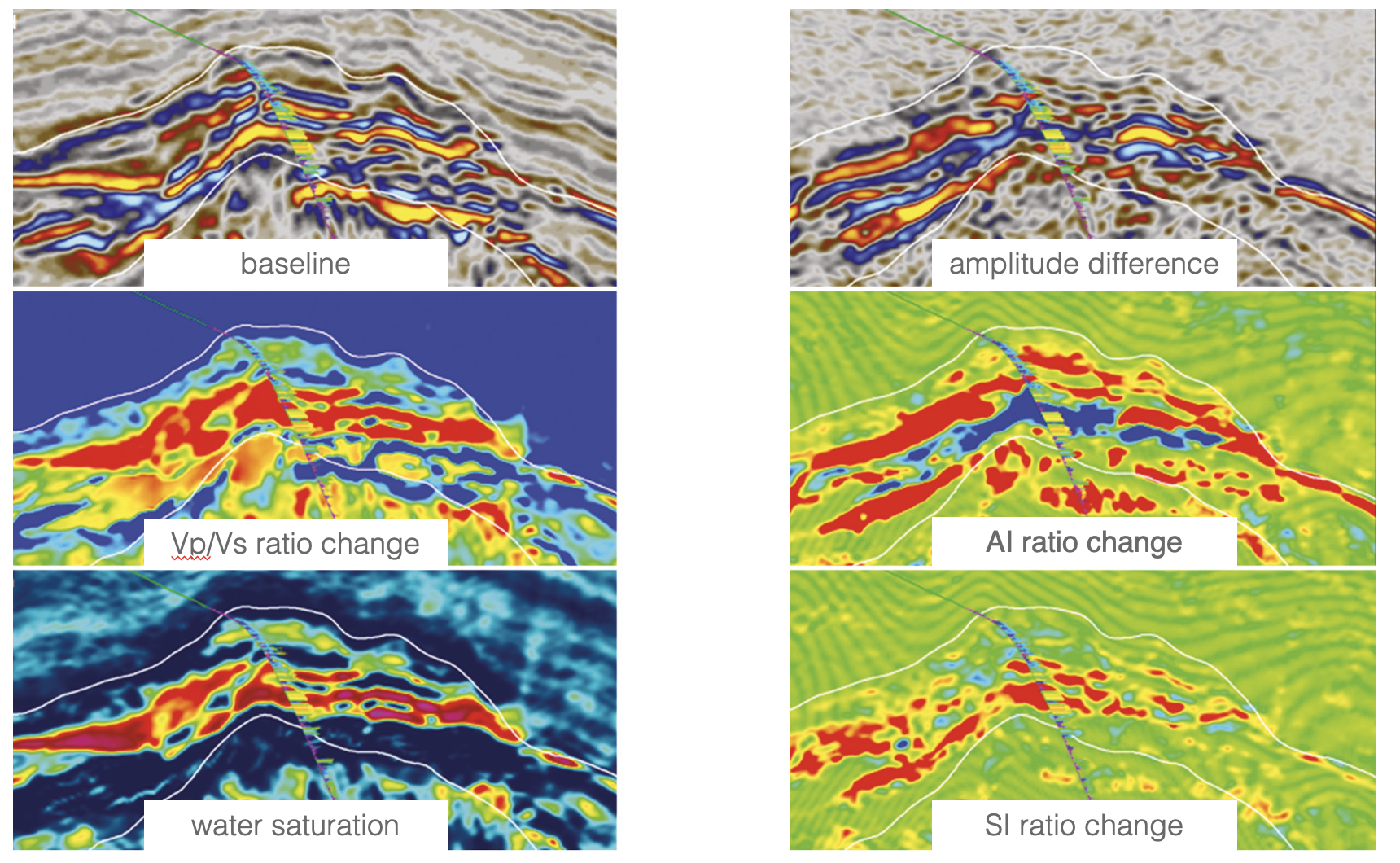
Qeye's elastic inversion results benefit from proprietary 4DAVO friendly preconditioning.
Qeye simultaneously inverts angle stacks from multiple monitor datasets directly for the changes in elastic parameters.
Qeye delivers calibrated volumes of saturation changes that can be directly compared with reservoir simulations.


"4D seismic shows that the reservoir has changed. Our inversion and rock physics workflow helps explain why — separating saturation and pressure effects so the data becomes actionable."
Time lapse inversion
Qeye’s 4D AVO inversion is designed to extract production-related changes from time-lapse seismic data in a robust and quantitative way. Instead of treating one survey as the fixed baseline and comparing all monitor surveys back to it, our simultaneous 4D inversion treats all vintages symmetrically. This means each survey contributes equally to the inversion, reducing baseline dependency and improving consistency across the full 4D dataset.
The method uses preconditioned seismic partial stacks from each vintage, together with optimized wavelets and low-frequency models, to invert directly for elastic properties and their time-lapse changes. The output includes acoustic impedance, Vp/Vs and density, as well as 4D changes linked to production effects such as fluid movement, pressure depletion or pressure support.
A typical 4D AVO inversion workflow includes selecting the optimal wavelets for each angle stack and vintage, testing the number of input stacks, optimizing inversion parameters, running relative and absolute inversion tests, and delivering final elastic-property volumes together with monitor-change volumes.
The result is a more reliable basis for separating competing 4D effects, interpreting reservoir changes and supporting decisions around infill drilling, sweep efficiency and reservoir management.
Estimating Saturation and Pressure Changes
Qeye’s time-lapse inversion can be taken one step further by integrating the 4D elastic changes with calibrated rock physics models. Changes in acoustic impedance, shear impedance and Vp/Vs are interpreted through rock physics scenarios that describe how the reservoir should respond to fluid substitution, pressure depletion or pressure support.
This allows us to separate competing 4D effects that may look similar in conventional seismic difference volumes. For example, fluid replacement mainly affects acoustic properties, while pressure or effective-stress changes can also influence the shear response. By combining 4D AVO inversion, time-shift information and rock physics modelling, we can estimate changes in saturation and pressure in a way that is consistent with both the seismic data and the expected reservoir physics.
The result is a more quantitative view of production effects, helping identify swept and unswept areas, pressure communication, bypassed hydrocarbons and opportunities for improved reservoir management.